
Pressure Die Casting vs Gravity Die Casting
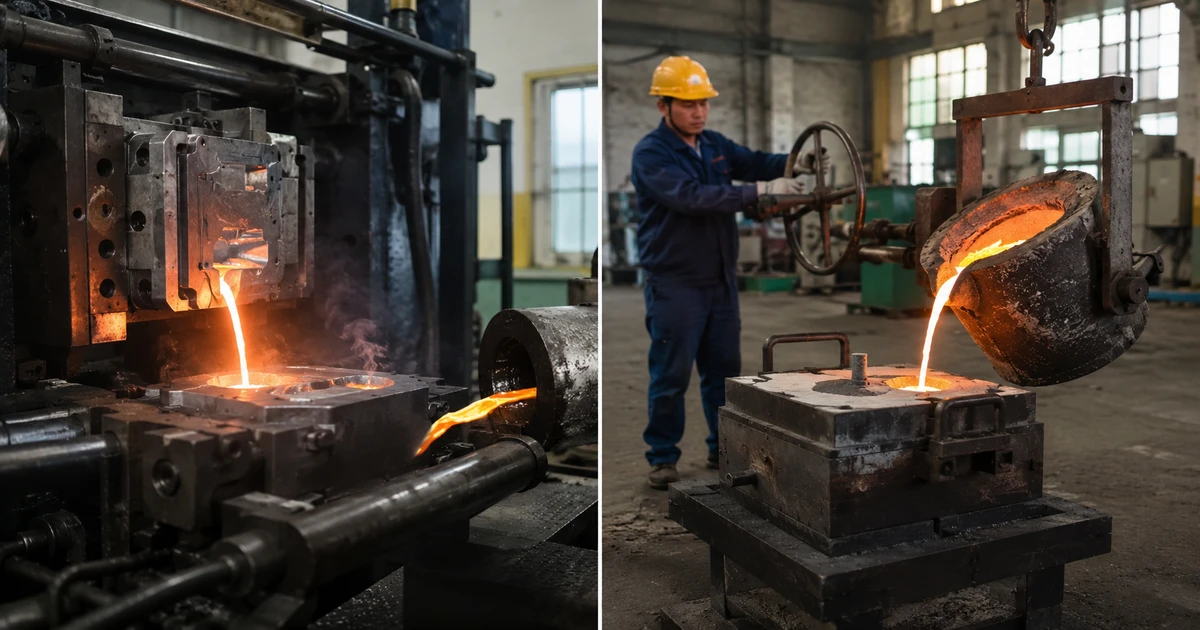
What is Pressure Die Casting?
Pressure die casting is a manufacturing process in which molten metal is injected into a steel mold under high pressure. The molten metal rapidly fills the mold cavity, allowing manufacturers to produce highly accurate and complex metal components with smooth surface finishes. This process is widely used for high-volume production because it supports faster manufacturing cycles, consistent quality, and excellent dimensional precision. Pressure die casting is commonly used with aluminum, zinc, and magnesium alloys in industries such as automotive, aerospace, electronics, and industrial machinery. Pressure die casting is especially suitable for manufacturing lightweight and precision-engineered components that require tight tolerances and efficient large-scale production.
What is Gravity Die Casting?
Gravity die casting is a metal casting process in which molten metal is poured into a reusable mold using gravitational force instead of external pressure. The molten metal naturally flows into the mold cavity and solidifies into the desired component shape. This process is commonly used for producing strong and durable metal components with good mechanical properties and structural integrity. Gravity die casting is generally preferred for medium-volume production where component strength and durability are important requirements. The process is widely used in automotive, heavy engineering, industrial machinery, and structural component manufacturing applications.
Importance of Choosing the Right Die Casting Process
Selecting the correct die casting process is very important because manufacturing requirements differ depending on component design, production volume, material type, and performance expectations. Pressure die casting is ideal for manufacturers requiring high production efficiency, precision, and faster manufacturing cycles. On the other hand, gravity die casting is often selected for applications requiring stronger structural properties and durable industrial components. Both manufacturing methods play an important role in modern engineering industries by supporting efficient production and reliable component manufacturing.
Difference Between Pressure Die Casting and Gravity Die Casting
One of the biggest differences between pressure die casting and gravity die casting is the method used to fill the mold cavity. In pressure die casting, molten metal is injected into the mold under high pressure, enabling faster mold filling and improved dimensional accuracy. This helps manufacturers produce complex components with excellent consistency and smooth surface finishes. In gravity die casting, molten metal enters the mold naturally through gravitational force without external pressure. The process is slower compared to pressure die casting but often provides better structural strength and internal integrity. Pressure die casting mainly focuses on production speed, precision, and large-scale manufacturing efficiency, while gravity die casting focuses more on strength, durability, and mechanical performance.
Industries That Use Pressure Die Casting and Gravity Die Casting
Pressure die casting is widely used in automotive, aerospace, electronics, consumer goods, and industrial manufacturing industries because it supports mass production and high-precision manufacturing. Automotive manufacturers use pressure die casting for engine housings, brackets, transmission components, and lightweight structural parts. Electronics industries also depend on pressure die casting for manufacturing precision metal housings and engineering components.Gravity die casting is commonly used in heavy engineering, industrial machinery, automotive applications, and structural manufacturing industries where strong and durable metal components are required. Both manufacturing methods are important for producing industrial components capable of meeting modern engineering standards and performance requirements.
1. Production Speed and Manufacturing Efficiency
Pressure die casting offers faster production cycles compared to gravity die casting because molten metal is injected into the mold under high pressure. This allows manufacturers to produce large quantities of components quickly and efficiently. The process is highly suitable for industries requiring mass production and shorter manufacturing timelines. Gravity die casting has relatively slower production cycles because the molten metal flows into the mold naturally without pressure assistance. However, it still provides reliable manufacturing efficiency for medium-scale production requirements.
2. Surface Finish and Dimensional Accuracy
Pressure die casting is widely known for producing components with excellent dimensional precision and smooth surface finishes. The high-pressure injection process allows molten metal to fill complex mold cavities accurately. This reduces the need for additional machining and post-processing operations, helping manufacturers reduce production costs and improve efficiency. Gravity die casting also produces good surface quality and dimensional accuracy, although it may not achieve the same level of fine detailing as pressure die casting for highly complex components.
3. Strength and Structural Performance
Gravity die casting generally produces components with better structural strength and mechanical properties due to the slower filling and solidification process. This helps reduce internal stress and improves the durability of the finished component. Pressure die casting also produces durable components, but the process is primarily optimized for high-speed manufacturing, precision, and production efficiency. The selection between the two methods depends on whether the manufacturing priority is production speed or structural performance.
4. Future of Die Casting Technologies
As industries continue adopting advanced engineering and automation technologies, both pressure die casting and gravity die casting will continue evolving to meet modern manufacturing demands. Manufacturers are increasingly focusing on energy-efficient systems, smart manufacturing technologies, sustainable production methods, advanced tooling solutions, and improved quality control systems. The future of die casting will depend on manufacturing processes that combine precision, efficiency, durability, and cost effectiveness to support growing industrial requirements.
Final Conclusion
Pressure die casting and gravity die casting are both important manufacturing processes used for producing high-quality metal components for modern industries. Although both processes serve similar purposes, they differ in terms of manufacturing technique, production speed, dimensional accuracy, structural strength, and industrial applications. Pressure die casting is ideal for high-volume production, precision manufacturing, and faster production cycles, while gravity die casting is more suitable for applications requiring strong and durable structural components
Industries such as automotive, aerospace, industrial machinery, electronics, and engineering manufacturing continue to rely heavily on both die casting methods to produce reliable and cost-effective components. With continuous advancements in automation, tooling technologies, and manufacturing infrastructure, both pressure die casting and gravity die casting will remain essential solutions supporting the future growth of industrial manufacturing and precision engineering.